Why Do Some Games Remain Fun for Decades?
Thousands of games are released every year.
Most disappear.
A few survive for generations.
Why?
Researchers, designers, and psychologists have studied this question for decades. Surprisingly, many of the answers are not related to graphics, technology, or budget.
The most memorable games often rely on a small number of timeless design principles.
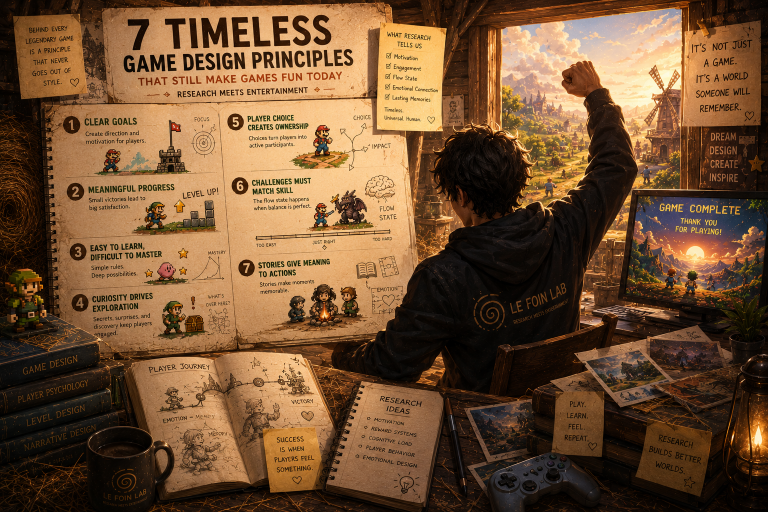
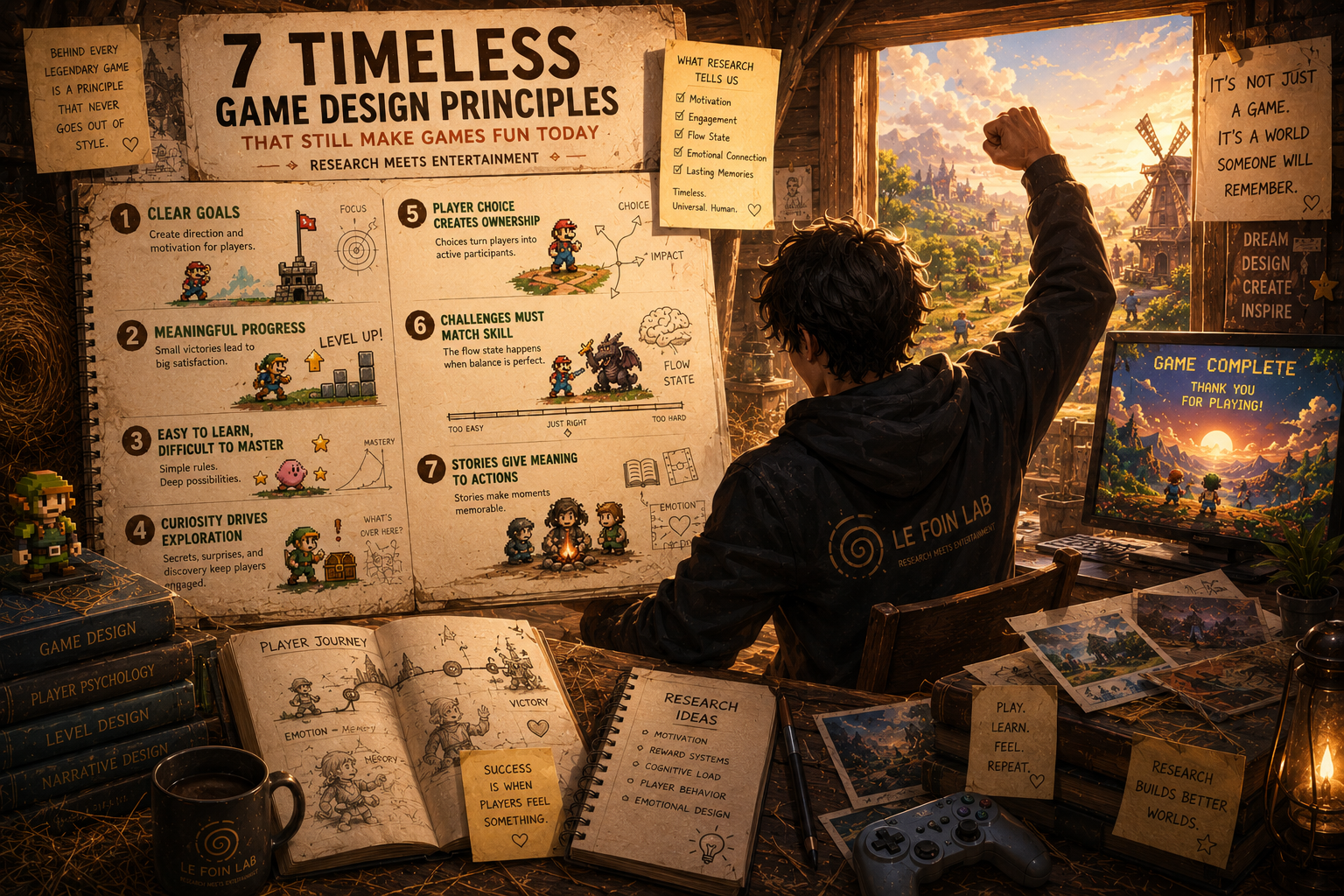
Let’s explore seven game design ideas that continue to shape successful games today.
1. Clear Goals Create Motivation
Players enjoy knowing what they are trying to achieve.
Classic games often provided simple objectives:
- Reach the flag.
- Solve the puzzle.
- Defeat the boss.
- Build the city.
Research suggests that clear goals reduce cognitive load and help players enter a state of focus.
When players understand the objective, they can concentrate on the experience instead of figuring out what to do next.
2. Meaningful Progress Feels Rewarding
Humans enjoy seeing progress.
This is one of the strongest findings in behavioral psychology.
Classic games constantly provide small victories:
- New levels
- Better tools
- New areas
- Unlockable content
These rewards encourage players to continue exploring.
The progress itself becomes part of the entertainment.
3. Easy to Learn, Difficult to Master
Many legendary games follow a simple formula:
Learn quickly.
Master slowly.
Chess, Tetris, platformers, arcade games, and card games all share this principle.
The rules are easy to understand.
The depth emerges over time.
This balance makes games accessible while maintaining long-term engagement.
4. Curiosity Drives Exploration
Players love discovering something hidden.
Research in game psychology shows that curiosity activates powerful motivational systems.
Classic games encouraged exploration through:
- Secret rooms
- Hidden treasures
- Unlockable characters
- Unexpected discoveries
Curiosity transforms gameplay into adventure.
Players begin asking:
“What happens if I go over there?”
That question alone can drive hours of engagement.
5. Player Choice Creates Ownership
People value experiences more when they participate in shaping them.
Games become memorable when players feel responsible for outcomes.
Examples include:
- Choosing a character
- Selecting a path
- Building a city
- Designing a home
Even small choices increase emotional investment.
The experience becomes personal.
6. Challenges Must Match Skill
Psychologist Mihaly Csikszentmihalyi introduced the concept of Flow State.
Flow occurs when challenge and skill remain balanced.
If a game is too easy:
Players become bored.
If it is too difficult:
Players become frustrated.
Great games continuously adjust difficulty to keep players engaged.
This principle has guided game design for decades.
7. Stories Give Meaning to Actions
Players rarely remember every mechanic.
They remember moments.
Stories provide context for gameplay.
A simple task becomes meaningful when connected to:
- Characters
- Relationships
- Mystery
- Discovery
- Purpose
This explains why narrative games continue to grow in popularity.
Stories transform actions into memories.
What Research Tells Us About Great Games
Across different genres and generations, successful games often share similar characteristics:
- Clear goals
- Meaningful progression
- Curiosity
- Player choice
- Balanced challenge
- Emotional connection
Technology changes.
Human psychology changes much more slowly.
That is why design principles from decades ago still work today.
Why Classic Games Continue to Inspire Developers
Many modern developers study classic games not because they are old, but because they solved timeless design problems.
A game released thirty years ago may still teach valuable lessons about:
- Motivation
- Exploration
- Storytelling
- Player engagement
Understanding these foundations helps developers create stronger experiences today.
How Le Foin® Lab Approaches Game Research
At Le Foin® Lab, we believe game development is both an artistic and scientific discipline.
Our philosophy, Research Meets Entertainment, encourages us to study how people learn, explore, imagine, and connect through interactive experiences.
By combining research, storytelling, comics, software, and game design, we seek to build worlds that are both meaningful and enjoyable.
Because behind every memorable game is a deeper understanding of human curiosity.
Final Thoughts
The games we remember most are rarely defined by technology alone.
They succeed because they understand people.
The principles that shaped classic games continue to guide modern game development because human motivation remains surprisingly consistent.
As new technologies emerge, the future of gaming may look different.
But the foundations of great game design remain timeless.
About the Author