
Do You Have to Believe in Tarot for It to Work?
One of the most common questions beginners ask is surprisingly simple:
“Do I have to believe in tarot for it to work?”
Some people approach tarot with deep spiritual beliefs. Others are skeptical, viewing the cards as nothing more than illustrated paper.
Yet many first-time users are surprised by how meaningful the experience feels—even when they don’t believe in fortune telling.
So what is really happening?
Tarot Is a Tool, Not a Test of Belief
Think about a mirror.
You don’t have to believe in mirrors for them to reflect your face.
Likewise, many people use tarot not because they expect magical predictions, but because the cards encourage reflection from unexpected perspectives.
The value often comes from the questions they inspire rather than the answers they appear to provide.
Psychology Suggests Openness Matters More Than Belief
Research in cognitive psychology shows that curiosity and openness can improve reflective thinking.
When people allow themselves to consider different interpretations, they generate more possibilities and often discover solutions they had previously ignored.
Tarot cards create exactly this situation.
Instead of giving direct instructions, they present symbols that invite interpretation.
Your mind does the rest.
Skeptics Can Benefit Too
Many experienced tarot readers admit that some of their most interesting sessions involve skeptical participants.
Because skeptics tend to question assumptions, they often engage more deeply with the symbolism.
Rather than asking:
“Is this prediction true?”
they ask:
- Why does this image catch my attention?
- Why do I disagree with this interpretation?
- What emotion does this card trigger?
Those questions can lead to valuable self-awareness.
Symbols Have Always Helped Humans Think
Throughout history, humans have used symbols to organize ideas.
Maps simplify geography.
Equations simplify physics.
Stories simplify complex emotions.
Tarot cards simplify human experiences into visual metaphors.
A journey.
A choice.
A collapse.
A transformation.
These themes are universal, which is why different people can connect with the same card in different ways.
Belief Is Optional. Reflection Is Essential.
If someone expects tarot to magically solve every problem, disappointment is likely.
If someone uses tarot as a framework for reflection, decision-making, and self-exploration, the experience can become surprisingly meaningful.
The cards cannot make your decisions.
They can encourage you to think about your decisions differently.
A Better Question to Ask
Instead of asking:
“Do I believe in tarot?”
try asking:
- Does this perspective help me understand myself?
- Does it encourage better questions?
- Does it reveal assumptions I hadn’t noticed?
- Does it inspire wiser decisions?
Those questions are valuable regardless of your beliefs.
Final Thoughts
Tarot does not require blind faith.
It requires curiosity.
Whether you see the cards as psychology, symbolism, spirituality, or simply a creative thinking exercise, their greatest strength may be their ability to slow us down and invite honest reflection.
At Le Foin® Lab, we encourage exploration over certainty. The goal is not to tell you what to believe, but to create space where science, imagination, and human experience can meet—and where better questions lead to deeper understanding.
Continue Your Journey
👉 How Does Tarot Reading Work? A Beginner’s Guide
👉 Can Tarot Predict the Future? Science vs Belief
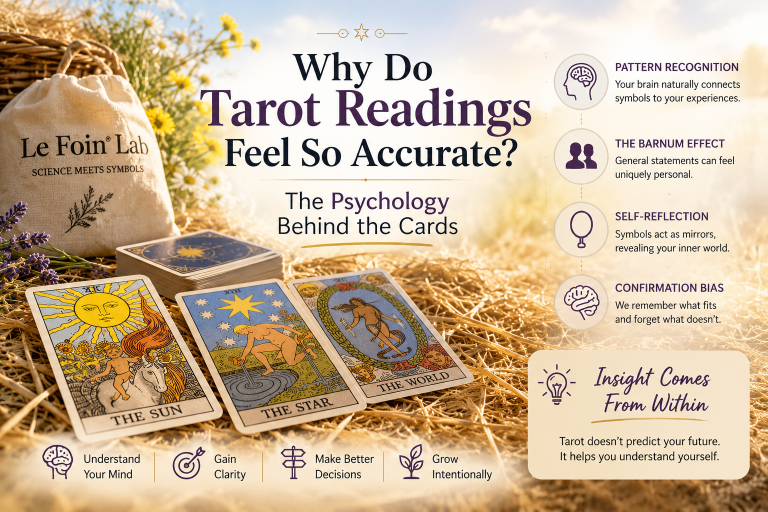
👉 Why Do Tarot Readings Feel So Accurate? The Psychology Behind the Cards
✨ Start Your Free Tarot Reading → https://tarot.lefoinlab.com
At Le Foin® Lab
We believe curiosity grows when science and imagination meet. Rather than telling you what to believe, we invite you to ask better questions—and discover your own answers through thoughtful exploration.