
Many people walk away from a tarot reading with the same thought:
“How could those cards know exactly what I’m going through?”
For believers, the answer may involve intuition, energy, or destiny. For skeptics, it may seem like coincidence.
Interestingly, psychology offers another explanation that doesn’t diminish the experience—it helps us understand why tarot can feel deeply personal.
The Human Brain Is a Pattern-Seeking Machine
Our brains evolved to find patterns.
Long before modern civilization, recognizing patterns helped humans survive. Identifying animal tracks, predicting weather changes, or noticing dangerous environments increased the chances of staying alive.
That same ability still shapes how we interpret information today.
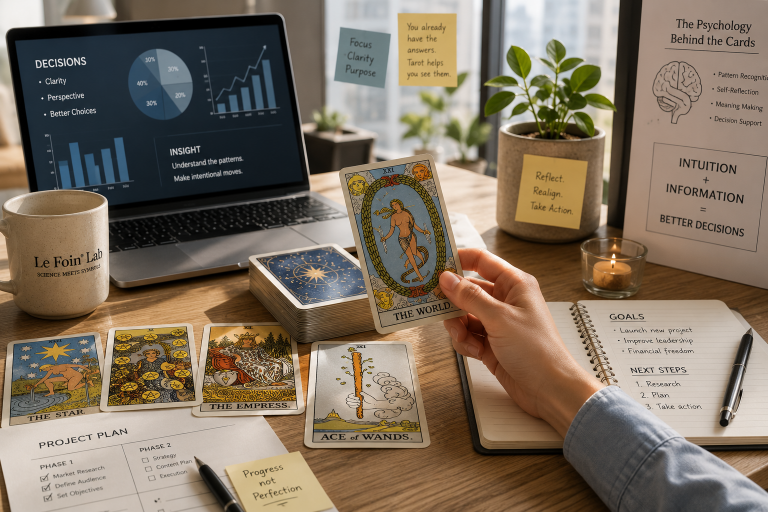
When we see symbolic images on tarot cards, our minds naturally begin connecting them to our own memories, emotions, and current situations.
The cards themselves don’t contain your story.
Your brain builds the story.
The Barnum Effect
Psychologists describe a phenomenon called the Barnum Effect, where people tend to accept broad descriptions as uniquely personal.
Statements like:
- “You sometimes doubt yourself.”
- “You’ve experienced disappointment but continue moving forward.”
- “You want stability but also fear missing opportunities.”
apply to many people.
Yet individuals often feel these descriptions are remarkably accurate because they relate them to their own experiences.
Tarot interpretations sometimes work in a similar way—but that is only part of the explanation.
Symbols Invite Reflection
Unlike direct advice, tarot cards communicate through symbols.
A tower collapsing.
A traveler beginning a journey.
A person balancing two choices.
These images are intentionally open-ended, allowing multiple interpretations.
Psychologists call this projective interpretation: when ambiguous stimuli encourage people to reveal their own thoughts and emotions.
In many ways, the card functions like a mirror rather than a prediction.
Reflection Creates Insight
Imagine asking yourself:
- Should I change careers?
- Am I holding onto a relationship that no longer serves me?
- What is preventing my growth?
Looking at symbolic imagery forces your mind to organize scattered thoughts into a coherent narrative.
The insight often feels as though it came from the card.
But it may actually come from your own subconscious reasoning.
The card simply provided a structure for reflection.
Emotion Improves Memory
People remember emotionally significant experiences much better than ordinary events.
If a tarot reading occurs during a stressful period—career uncertainty, heartbreak, or major life transitions—the emotional intensity strengthens memory formation.
Later, when events unfold, we naturally recall the parts that matched reality while forgetting interpretations that didn’t.
Psychologists refer to this tendency as confirmation bias, a common feature of human cognition.
Science Doesn’t Necessarily Eliminate Meaning
Understanding these psychological mechanisms doesn’t make tarot meaningless.
In fact, many modern therapists and coaches use storytelling, visualization, and symbolic exercises to help clients gain perspective.
Tarot can serve a similar purpose:
- encouraging self-reflection,
- organizing emotions,
- generating new viewpoints,
- stimulating honest conversations with ourselves.
Its value may lie less in predicting tomorrow and more in understanding today.
A Scientific Way to Approach Tarot
Rather than asking:
“Will this happen?”
consider asking:
- What am I overlooking?
- What assumptions am I making?
- Which fear is influencing my decision?
- What opportunity have I ignored?
These questions transform tarot from a fortune-telling device into a framework for critical thinking and personal reflection.
Final Thoughts
Whether you see tarot as spirituality, psychology, or simply creative storytelling, one fact remains:
Humans understand themselves through narratives.
The cards may not contain magical answers, but they can inspire meaningful questions.
And sometimes, asking the right question is far more valuable than receiving a certain prediction.
At Le Foin® Lab, we believe curiosity and scientific thinking can coexist with imagination. Tarot is not presented as proof of supernatural knowledge, but as a symbolic tool that encourages reflection, self-awareness, and deeper exploration of the human mind.
🃏 New to Tarot? Start Here
- ⭐ How Does Tarot Reading Work? (Beginner)
- ⭐ Why Do Tarot Readings Feel So Accurate?
- ⭐ Can Tarot Predict the Future?
- ⭐ The Complete Guide to Major Arcana
- ⭐ Free Tarot Reading →
At Le Foin® Lab
We believe curiosity grows when science and imagination meet. Rather than telling you what to believe, we invite you to ask better questions—and discover your own answers through thoughtful exploration.